Closure Properties of Context-Free Languages
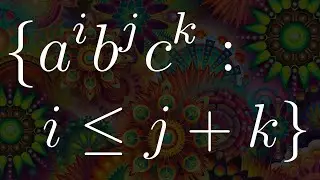
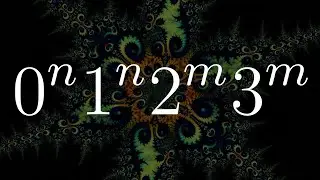
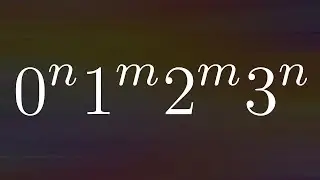
Here we look at the five main closure properties--Union, Concatenation, Star, Intersection, and Complement--and show whether they are closed operations for context-free languages. We show that the first three are closed (just by making a simple additional rule to the original grammars), and the other two are not, by being able to produce {a^n b^n c^n : n at least 0}, which is not a CFL.
What is a context-free grammar? It is a set of 4 items: a set of "variables," a set of "terminals," a "start variable," and a set of rules. Each rule must involve a single variable on its "left side", and any combination of variables and terminals on its right side. See • Context-Free Grammars (CFG) and Conte... for more details.
Patreon: / easytheory
If you like this content, please consider subscribing to my channel: / @easytheory
▶ADDITIONAL QUESTIONS◀
1. Can you find an explicit example of a CFL whose complement is not a CFL?
2. Are non-CFLs also closed under the same operations?
▶SEND ME THEORY QUESTIONS◀
[email protected]
▶ABOUT ME◀
I am a professor of Computer Science, and am passionate about CS theory. I have taught over 12 courses at Arizona State University, as well as Colgate University, including several sections of undergraduate theory.
En esta página del sitio puede ver el video en línea Closure Properties of Context-Free Languages de Duración hora minuto segunda en buena calidad , que subió el usuario Easy Theory 01 enero 1970, comparta el enlace con amigos y conocidos, en youtube este video ya ha sido visto 22,062 veces y le gustó 391 a los espectadores. Disfruta viendo!