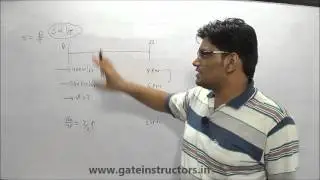
First and Follow solved Examples Part 1 | Syntax Analysis LL(1) Parsing Table | 68
Playlist for all videos on this topic: • Compiler Design (COMPUTER SCIENCE) Vi...
Automata Theory, in hindi, lectures, iit, tutorial, First Follow solved examples Part 1 Video lecture for gate exa m preparation CS IT MCA, first and follow in compiler, how to calculate first and follow in compiler design, compute first and follow for the grammar,
S ::= aBA | BB | Bc
A ::= Ad | d
B ::= ε
We have
FIRST(B) = FIRST(ε)
= {ε}
FIRST(A) = FIRST(Ad) ∪ FIRST(d)
= FIRST(A) ∪ {d}
= {d}
FIRST(S) = FIRST(aBA) ∪ FIRST(BB) ∪ FIRST(Bc)
= FIRST(a) ∪ (FIRST(B)\{ε}) ∪ FIRST(B) ∪ (FIRST(B)\{ε) ∪ FIRST(c)
= {a, ε, c}
Consider the following grammar
FOLLOW
1
(T’) = { +, ), # }
FOLLOW
1
We Want to make First sets so first we list the sets we need
FIRST(E) = {}
FIRST(E') = {}
FIRST(T) = {}
FIRST(T') = {}
FIRST(F) = {}
First We apply rule 2 to T' → ε and E' → ε
FIRST(E) = {}
FIRST(E') = {ε}
FIRST(T) = {}
FIRST(T') = {ε}
FIRST(F) = {}
First We apply rule 3 to T' → *FT' this rule tells us that we can add everything in First(*FT') into First(T')
Since First(*) useing rule 1 is * we can add * to First(T')
FIRST(E) = {}
FIRST(E') = {+,ε}
FIRST(T) = {}
FIRST(T') = {*,ε}
FIRST(F) = {}
First We apply rule 3 to T' → *FT' this rule tells us that we can add everything in First(*FT') into First(T')
Since First(*) useing rule 1 is * we can add * to First(T')
FIRST(E) = {}
FIRST(E') = {+,ε}
FIRST(T) = {}
FIRST(T') = {*,ε}
FIRST(F) = {}
Two more productions begin with terminals F → (E) and F → id If we apply rule 3 to these we get...
FIRST(E) = {}
FIRST(E') = {+,ε}
FIRST(T) = {}
FIRST(T') = {*,ε}
FIRST(F) = {'(',id}
Next we apply rule 3 to T → FT' once again this tells us that we can add First(FT') to First(T)
Since First(F) doesn't contain ε that means that First(FT') is just First(F)
FIRST(E) = {}
FIRST(E') = {+,ε}
FIRST(T) = {'(',id}
FIRST(T') = {*,ε}
FIRST(F) = {'(',id}
Lastly we apply rule 3 to E → TE' once again this tells us that we can add First(TE') to First(E)
Since First(T) doesn't contain ε that means that First(TE') is just First(T)
FIRST(E) = {'(',id}
FIRST(E') = {+,ε}
FIRST(T) = {'(',id}
FIRST(T') = {*,ε}
FIRST(F) = {'(',id}
We want to make Follow sets so first we list the sets we need
FOLLOW(E) = {}
FOLLOW(E') = {}
FOLLOW(T) ={}
FOLLOW(T') = {}
FOLLOW(F) = {}
The First thing we do is Add $ to the start Symbol 'E'
FOLLOW(E) = {$}
FOLLOW(E') = {}
FOLLOW(T) ={}
FOLLOW(T') = {}
FOLLOW(F) = {}
Next we apply rule 2 to E' →+TE' This says that everything in First(E') except forε should be in Follow(T)
FOLLOW(E) = {$}
FOLLOW(E') = {}
FOLLOW(T) ={+}
FOLLOW(T') = {}
FOLLOW(F) = {}
Next we apply rule 3 to E →TE' This says that we should add everything in Follow(E) into Follow(E')
FOLLOW(E) = {$}
FOLLOW(E') = {$}
FOLLOW(T) ={+}
FOLLOW(T') = {}
FOLLOW(F) = {}
Next we apply rule 3 to T → FT' This says that we should add everything in Follow(T) into Follow(T')
FOLLOW(E) = {$}
FOLLOW(E') = {$}
FOLLOW(T) ={+}
FOLLOW(T') = {+}
FOLLOW(F) = {}
Now we apply rule 2 to T' →*FT' This says that everything in First(T') except for ε should be in Follow(F)
FOLLOW(E) = {$}
FOLLOW(E') = {$}
FOLLOW(T) ={+}
FOLLOW(T') = {+}
FOLLOW(F) = {*}
Now we apply rule 2 to F → (E) This says that everything in First(')') should be in Follow(E)
FOLLOW(E) = {$,)}
FOLLOW(E') = {$}
FOLLOW(T) ={+}
FOLLOW(T') = {+}
FOLLOW(F) = {*}
Next we apply rule 3 to E → TE' This says that we should add everything in Follow(E) into Follow(E')
FOLLOW(E) = {$,)}
FOLLOW(E') = {$,)}
FOLLOW(T) = {+}
FOLLOW(T') = {+}
FOLLOW(F) = {*}
Next we apply rule 4 to E' → +TE' This says that we should add everything in Follow(E') into Follow(T) (because First(E') contains ε)
FOLLOW(E) = {$,)}
FOLLOW(E') = {$,)}
FOLLOW(T) = {+,$,)}
FOLLOW(T') = {+}
FOLLOW(F) = {*}
Next we apply rule 3 to T → FT' This says that we should add everything in Follow(T) into Follow(T')
FOLLOW(E) = {$,)}
FOLLOW(E') = {$,)}
FOLLOW(T) = {+,$,)}
FOLLOW(T') = {+,$,)}
FOLLOW(F) = {*}
Finaly we apply rule 4 to T' → *FT' This says that we should add everything in Follow(T') into Follow(F)
FOLLOW(E) = {$,)}
FOLLOW(E') = {$,)}
FOLLOW(T) = {+,$,)}
FOLLOW(T') = {+,$,)}
FOLLOW(F) = {*,+,$,)}
first and follow examples
first and follow in compiler design
first and follow program in c
first and follow ppt
first and follow in compiler design ppt
first and follow algorithm
first and follow examples in compiler design pdf
first and follow parsing
In questa pagina del sito puoi guardare il video online First and Follow solved Examples Part 1 | Syntax Analysis LL(1) Parsing Table | 68 della durata di ore minuti seconda in buona qualità , che l'utente ha caricato Gate Instructors 15 aprile 2015, condividi il link con amici e conoscenti, su youtube questo video è già stato visto 39,958 volte e gli è piaciuto 133 spettatori. Buona visione!